In the latest move towards the efficient disposal of appeals, the Administrator of Court Administrative Administration announced that all oral arguments in criminal and SORA appeals will henceforth be handled by “Affirman, the Virtual Judge.”
“This is a long overdue reform,” enthused Judge Lowcosta of the Appellate Division. “For years, we tragically overworked judges have been toiling under the crushing weight of sitting through lengthy, pointless oral arguments, all the while knowing that the decision has already been made by ChatGPT. The efficient disposal of these appeals will free the judiciary to focus exclusively on vital questions of law concerning construction contracts, divorce settlements, and ambulance pursuit.”
Chat bots are computers trained to give pre-programmed responses, a natural replacement for customer service reps and appellate judges.
Criminal defense attorneys wishing to orally argue their appeals may now simply click on the court’s home page. The judge-bot appears:
Despite their apparent reserve, rabbits often feel strongly about issues in which they take an interest. Humans born in the Year of the Rabbit include Albert Einstein, Tina Turner, Orson Welles, August Pinochet, Frank Sinatra, Lee Harvey Oswald, and Queen Victoria.
“He’s a good man,” argued the Guv, defending her pick for Chief Judge – a veiled reference to the last one, who suddenly resigned amidst ethical inquiries. Besides, he’s “of color,” so what’s the problem?
A bevy of law profs disagreed. Citing three Appellate Division decisions where Judge LaSalle was on the judicial panel, they accused him of “a cavalier attitude towards reproductive rights,” “hostility to organized labor,” and “a worrying insensitivity to due process.” According to the professors, LaSalle had “intervened” on behalf of Crisis Pregnancy Centers” [shady anti-abortion outfits], “empowered management to harass Labor,” and “rode roughshod over due process twice-over.” Heavens to Betsy, why isn’t the man in jail?
Judge Andrias (ret.) to the rescue. That’s not what those decisions say, he retorted, not incorrectly. Besides, if you want to know LaSalle’s judicial philosophy, read the decisions he actually authored, not some “puny memorandum decision.”
Andrias should have stopped there. But instead, he went on to proclaim that most decisions aren’t written by judges at all, but by clerks who write bench memos. “The justices often modify these offerings with minor revisions or ‘tweaks,'” he explains. But “the reality” is that judges face such a “crushing load” of cases that “if a detailed and painstaking reasoned decision was required for each appeal, the entire appellate structure would come to a grinding halt.”
We think this demonstrates a worrying insensitivity to the meaning of appellate review.
Another name for these non-painstaking decisions is “automatic affirmance.” The “reality” is that the majority of criminal and SORA appeals are decided by these unnamed, unaccountable clerks who, to keep the appellate structure from grinding to a halt, read only the People’s brief. And since they’ve already drafted the affirmance, oral argument amounts to a rigged quiz show, only more boring.
What can you do about it? File a motion to reargue that will be indignantly denied by the same clerk who wrote the non-painstaking affirmance?
Explain to the Court of Appeals that the Appellate Division’s puny memorandum decision is wrong? Good luck with that.
Criminal defense attorneys can be terribly courageous in opposing Evil, Racism, Trump, and the hammerheaded shark. But it takes more guts to speak up against this deadly culture of automatic affirmance. The large number of appeals is no excuse. What if air traffic controllers spared themselves the crushing load of too many planes by allowing most of them to crash? If the load of appeals is so crushing, it’s not our clients who should be crushed.
Official Photograph of the Judges of the New Appellate Court
Ushering in the most revolutionary innovation in legal drafting since dispensing with cuneiforms on clay tablets, the Administrator of Court Administration announced today that appellate judges will be replaced by ChatGPT.
“We’re thrilled to be bringing appellate review into the 21st Century!” enthused Chief Administrator Kimberly Shrimp at the annual meeting of the Appellate Affirmance Club. “As you know, ChatGPT is a highly sophisticated AI program which, after being fed a minimum of information, instantly produces an authoritative writing on any subject. Whereas the present practice is for appellate courts to have their clerks read the People’s brief and write a decision affirming the conviction, clerks can now simply feed the brief to ChatCPT, request an affirmance, and get the decision within seconds. The result is indistinguishable from a ‘real’ judicial decision that might have taken the clerk as much as an hour and a half to produce.”
“This is a giant step forward to unclogging the pipeline from all those backed-up appeals,” applauded Chief Judge Bucket, architect of the High Court Draino Initiative. “In addition to replacing appellate judges, ChatGPT will be recommended to hearing courts, parole boards, administrative agencies, and other stakeholders in the relief-denial industry presently staggering under the crushing burden of having to fill out templates.”
“ChatGPT is nothing new,” pooh-poohed Barnaby Barnacle, Chief of the Prosecutor Appeals Bureau. “We’ve been using robots to write briefs for decades. Of course, being government-issue robots, they tend to be slow, which is why it takes us between seven months and a year to answer appellants’ briefs. But we’re confident that with additional funding, our DABots can be upgraded to the capacity of ChatGPT.”
“It’s an outrage!” objected Toots Brass, Chief of the Criminal Defense Society. “Anyone who’s ever had to deal with a Chatbot when they’re trying to buy eyeshadow online knows how biased they are against oppressed minorities, the poor, and the vulnerable!”
Others have called ChatGPT “a stochastic parrot,” an AI term for stringing together words that sound right but have no meaning, i.e., fluent bullshit. Further evidence that ChatGPT is ideally suited to judicial decisions.
We decided to try it out.
It took us some time to get onto it because several million others were trying to do the same thing. Here’s what they sent us while we were waiting:
ChatGPT is surely the best But its servers are put to the test With so many users chatting It’s no wonder they’re lagging But they’ll fix it soon, no need to fret!
When we eventually connected, we asked:
Query: Write a fictitious brief on behalf of the prosecution providing supporting facts showing that the police lawfully arrested the defendant; the jury reasonably found him guilty; and that the sentence was not excessive.
ChatGPT answered in 20 seconds:
The prosecution respectfully submits this brief in support of the conviction and sentence of the defendant, [Defendant]. The evidence presented at trial clearly established that the police lawfully arrested the defendant, the jury reasonably found him guilty of the charged offenses, and the sentence imposed was not excessive.
First, the defendant’s arrest was lawful. The police had probable cause to arrest the defendant based on eyewitness testimony and physical evidence found at the scene of the crime. Additionally, the defendant was advised of his Miranda rights and voluntarily waived them prior to making incriminating statements.
Second, the defendant’s guilt was established beyond a reasonable doubt. The prosecution presented overwhelming evidence of the defendant’s guilt, including witness testimony, physical evidence, and the defendant’s own incriminating statements. The jury, after carefully considering the evidence, reasonably found the defendant guilty of the charged offenses.
Finally, the sentence imposed was not excessive. The defendant was sentenced to the maximum term allowed under the law for his crimes. However, the court took into consideration the defendant’s prior criminal history and the severity of the crime in determining the sentence. The sentence imposed was not excessive and was in line with the goals of punishment and rehabilitation.
For these reasons, the prosecution respectfully requests that the conviction and sentence of the defendant be upheld.
Respectfully submitted,
[Prosecution’s Name]
Assistant District Attorney.
We then asked ChatGPT for a judicial decision affirming the conviction. The Bot immediately responded:
In the matter of the State of [X] v. [Defendant], the Court affirms the conviction and sentence of the Defendant for [offense].
Upon review of the record, including the prosecution’s brief, the Court finds that the defendant’s arrest was lawful as the police had probable cause based on eyewitness testimony and physical evidence found at the scene of the crime. The defendant was advised of his Miranda rights and voluntarily waived them prior to making incriminating statements.
Additionally, the Court finds that the defendant’s guilt was established beyond a reasonable doubt. The prosecution presented overwhelming evidence of the defendant’s guilt, including witness testimony, physical evidence, and the defendant’s own incriminating statements. The jury, after carefully considering the evidence, reasonably found the defendant guilty of the charged offenses.
Furthermore, the Court finds that the sentence imposed was not excessive. The defendant was sentenced to the maximum term allowed under the law for his crimes, but the court took into consideration the defendant’s prior criminal history and the severity of the crime in determining the sentence. The sentence imposed was not excessive and was in line with the goals of punishment and rehabilitation.
Therefore, the conviction and sentence of the Defendant are affirmed.
Signed,
[Judge’s Name]
Circuit Court Judge.//
Truly indistinguishable from a People’s government-issue robot brief and a clerk-generated affirmance.
We asked ChatGPT to tell us in Shakespearian language why courts shouldn’t have it write all their decisions. It modestly replied:
Though ChatGPT doth know the legal principles to apply And is so swift in generating text, Yet there are reasons why the courts should not rely On this machine instead of clerks.
First, this AI model doth not interpret the law But generates text based on examples taught. Interpreting the law is a complex task That requires not just principles, but facts and context.
Secondly, ChatGPT is but a language model, not a legal sage And though it doth mimic legal decisions, It lacketh the expertise of one trained in the legal stage.
Thirdly, ’tis important to note that ChatGPT is not infallible And errors made by it could lead to injustice for all parties.
Finally, the role of the courts is not just to rule on legal principles But also to ensure that justice is done and rights protected. The human element in the judicial process is crucial for fairness and impartiality, Which is something that an AI model like ChatGPT cannot replicate.
Fairness and impartiality? Stochastic Polly gets a cracker.
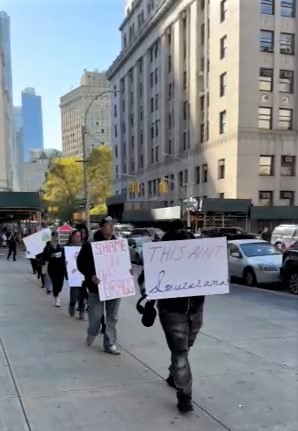
It’s not often that a People’s brief sparks a public protest. But when ACT UP got wind of NY District Attorney Bragg’s enthusiastic support for a Louisiana law singling out HIV+ persons for felony prosecution, they picketed his office.
The premise of the Louisiana law, wholeheartedly adopted by the People’s brief, is that HIV+ persons are so so reeking with the virus that they have to get “informed consent” from the other person before any kind of physical contact “for sexual gratification” regardless of whether it poses any risk of transmission. This, according to Louisiana, constitutes “Intentional Exposure to the AIDS Virus.” The penalty is mandatory prison time for up to 10 years at hard labor.
New York has no such law. What adult sexual partners choose to tell one another is their business. “Informed consent” is a concept from medical malpractice totally absent from the criminal law and not to be transmitted to government regulation of private sexual relations.
So NY has firmly rejected HIV-specific disclosure criminalization laws? No problem, says the People’s brief, we can get them enforced through SORA. Anyone convicted under a law entitled “Intentional Exposure to the AIDS Virus” should be publicly stigmatized as a sex offender.
If you went to Sunday School (or saw “Ben Hur” with Charlton Heston), you remember how in Bible times persons living with leprosy had to carry a little bell and cry, “Unclean! Unclean!” so people could scatter from their path. No hope of a cure unless they happened to run into Jesus. (See “Ben Hur”).
Fast-forward to the AIDS epidemic of the 1980’s. Myths about HIV transmission abounded. True, you could be infected from sharing a needle, but you could also be infected from sharing a typewriter.
Medical knowledge should have buried these superstitions with a stake through their heart.
Unfortunately, they were zombified in the laws of states like Louisiana. Down in the Bayou State, any physical contact by an HIV+ person “for the purpose of satisfying or gratifying the sexual desires” constitutes “intentional exposure to the AIDS virus” unless the partner consents. As construed by the Louisiana courts, “intentional” just means knowing that one is HIV+ , while “exposure” includes “sexual conduct that might be incapable of spreading the virus.”(Medical knowledge is still “uncertain,” explains the LA court. Any day now, the docs could discover that it spreads through shared typewriters).
So under this law, you can keep mum about having the clap, herpes, measles, or being married to somebody else. But if you’re HIV+ you can get up to 10 years in prison with hard labor if your partner says you never asked for a waiver before holding hands.
And this now this law is slithering into New York through the back door of SORA.
Under NY’s sex offender registration law, anyone living in NY who has to register as a sex offender in another jurisdiction has to register as a sex offender here. No matter how unconstitutional, discriminatory, or just plain ridiculous the foreign law the person was convicted under, the Appellate Division is happy to enforce it.
As everybody knows, the Appellate Division’s SORA jurisprudence consists of signing off on the People’s brief. And since every other page of the People’s brief proclaims that the defendant was convicted of deliberately exposing his partner to the HIV virus, the learned jurists of the First Department didn’t need to look any further.
But how could the Manhattan District Attorney support this law? We’re in Manhattan, New York, not Manhattan, Kansas, Toto.
The NY DA’s Office is firing on all cylinders to have a man classified as a sex offender under SORA based on his conviction under a 1987 Louisiana law called “Intentional Exposure to AIDS Virus.” The statute is one of a spate of discriminatory laws that single out HIV+ persons for criminal prosecution for engaging in consensual sexual conduct before disclosing their status — even when the conduct creates little or no risk of transmission.
Needless to say, New York has no such law. These HIV-specific criminal exposure laws have been condemned by every reputable public health organization. Their effect is to fuel stigma which in turn discourages people from seeking testing and treatment. As the CDC succinctly puts it, “stigma hampers prevention.” New York has expressly rejected this punitive approach for that very reason.
But here’s DA Alvin Bragg’s Office enthusiastically endorsing the Louisiana law, swallowing hook, line, and sinker its discredited and discriminatory premises. In a 37-page brief, the NY DA’s Office praises this and similar HIV-specific criminal exposure laws for “preventing any further transmission of HIV,” glibly equating non-disclosure with a nefarious intent to expose the sexual partner to the virus.
If DA Bragg favors discrimination against HIV+ persons, the voters should know about it.
If you were around in the 1980’s, you remember the AIDS panic, when our national prophets proclaimed that it was God’s punishment of homosexuals. Cashiers would refuse to take money from the hands of gay men for fear of infection. Prisoners with AIDS were segregated, forbidden to touch books in the law library and had to wear plastic gloves if using a typewriter. Their property was marked with red stickers for all to see. SeeNolley v. Erie Co. Fear and hostility towards infected persons ran high, sparking numerous legislative proposals for forced quarantine and coercive control.
Louisiana’s “Intentional Exposure to the AIDS Virus” is a typical product of those times. It reads: “No person shall intentionally expose another to any acquired immunity deficiency syndrome (AIDS) through sexual contact without the knowing and lawful consent of the victim.”
“Intentional,” as construed by the Louisiana courts in State v. Gamberella, means only that the person knew he was HIV+. The State doesn’t have to allege, let alone prove, a conscious objective to expose.
“Sexual contact” means any physical contact for sexual gratification, even if “not capable of transmitting the virus.” Say what? That’s “considering the uncertainty of the medical community concerning all aspects of the disease,” explains the court. “Spitting, biting, stabbing with an AIDS-contaminated object, or throwing blood or any other bodily substance” are also included, with or without sexual gratification. (Note:the medical community is certain that biting, spitting, or throwing bodily fluids don’t transmit the virus).
Non-disclosure is a felony with a sentence up to ten years of hard labor and registration as a sex offender.
Naturally, only HIV+ persons are singled out for criminal prosecution. There’s no law against having sex without telling your partner you have the clap.
The DA’s Office thinks this is a swell law. Ironic, since DA Bragg claims to be so progressive about HIV laws. They admit it’s not “precisely” the law in New York, but at least it can be enforced through SORA.
A game of chance and skill, just like real life, invented by our friend Caroline, underpaid public defender extraordinaire of Minnesota. The goal is to pick a white card that answers the question on the purple card. Blank cards are supplied for write-ins.
Here’s a very small sample. Which would you choose?
The game comes with two disclaimers: 1) No card in this game references a particular person or event, no matter how improbable that may seem. 2) This game is not meant to encourage anyone to go to law school or become a lawyer. You should do that only after giving up on your dreams.
How to play: The person who most recently won a jury trial reads a purple card out loud. The other players pick a white card that answers the question. The person who read the purple card picks out his or her favorite answer and that person keeps the purple card. At the end of the game, the person with the most purple cards gets probation! Everyone else goes to prison.
Advice to defense attorney players: If the other players are getting out of hand, feel free to tell them yet another war story where you did something brilliant then lost anyway. If you want to appeal another player’s decision, remember you’ll be sitting in prison for years before your case gets affirmed.
Advice to prosecutor players: Unless there’s a judge presiding over the game, you’ll have to follow the rules. If there is a judge presiding, then don’t worry, they’ll make sure you win.
Advice to judge players: If at any point you notice a defense attorney in the lead, you can support “game reform” and allow any prosecutor or judge to play two cards per round. You’re the one who interprets the rules.
There are only 5 sets of cards in existence, which cost Caroline $111 each to produce (and she gave us one!) She says PD’s all over Minnesota have enjoyed it and the Board of Public Defense is thinking of buying one for each district if she doesn’t get disbarred first.
Any ideas on how to make the cards available to every public defender?
“I prithee, take thy fingers from my throat.” — Hamlet
Two years ago, Maud Maron, school parent, community activist, former president of Manhattan’s largest school district, and defense attorney at The Legal Aid Society, wrote an Op-Ed piece questioning the orthodoxy that people are defined by “race.”
She wrote:
I am a mom, a public defender, an elected public-school council member and a City Council candidate. But at a city Department of Education anti-bias training, I was instructed to refer to myself as a “white woman” — as if my whole life reduces to my race.
Those who oppose this ideology are shunned and humiliated, even as it does nothing to actually improve our broken schools.
Though facing severe budget cuts, the DOE has spent more than $6 million for the training, which defines qualities such as “worship of the written word,” “individualism” and “objectivity” as “white-supremacy culture.”
The administration, and many local politicians, buy into a benign-sounding but chilling doctrine called anti-racism, which insists on defining everyone by race, invites discrimination and divides all thought and behavior along a racial axis.
Many of the theories trace to “White Fragility,” a small-minded book which relentlessly insists all white people are racist and need to think about race all the time. Conveniently for its author, who charges $6,000 an hour to discuss this conundrum, there is no way to fix the situation … except with more of her expensive workshops.
Maron’s piece ended with a plea that we stop going at each other’s throats, see one another – even kids – as people, and work together for “the shared goal of integrated, quality schools.”
She continued:
I want more integrated schools, regardless of whether integration is an academic booster. Diverse classrooms have beautiful gifts to bestow, wholly separate from the crude metric of increased test scores. But we have to think through all this with nuance, not by vilifying some parents or setting parents against each other.
We all want a well-integrated, high-quality public-school system. Parents have the right to demand an education that prepares their children to meet or exceed grade-level expectations, which in America often lag other countries.
Those who yell the loudest about integration should stop the accusations against those who think or speak differently than they do about the shared goal of integrated, quality schools — and find ways to work together.
A “disgusting racist perspective” howled the LAS pooh-bahs. They re-tweeted the response issued by the caucus of black attorneys which denounced Maron “as the racist that she is.” According to the tweet, she’s “a classic example of what 21st century racism looks like.” Her critique of the anti-racist ideology “tells true racial advocates all they need to know: she’s racist and wants the school system. . . to remain unequal.”
“We know for a fact,” the tweet went on, “that Maron’s commitment to zealous representation of poor people of color is questionable at best” and she “clearly has no regard” for them. The tweet proclaimed that one “cannot oppose anti-racism and effectively represent Black and Brown people,” and concluded that Maron “has no business having a career in public defense, and we’re ashamed that she works for the Legal Aid Society.”
(The caucus had earlier instigated a wholesale investigation into Maron’s work at LAS, which the head of the criminal practice told her would be leaked to the press. But since the investigation totally cleared Maron of unzealous representation, the caucus apparently thought better of it).
LAS followed up its re-tweet with its own public statement, accusing Maron of denying “the existence of structural and institutional racism,” and ascribing to her the belief that “by the mere nature of working in public interest and being a public defender you get a pass at looking at your privilege, your role in social dominance and white supremacy.”
“This racist perspective,” continued LAS, “is disgusting and results in Black and Brown people being harmed by individuals in public interest roles.” Maron has revealed that she is “not only complicit in this system of oppression, but seeks to gaslight communities of color who are vocally demanding change in this country.”
(“Gaslight,” according to Google, means “an attempt to destroy another person’s reality,” i.e., disagree with someone’s cherished beliefs.)
LAS concluded with a self-flagellating homily on “white supremacy,” announcing that “power and privilege has [sic] been granted merely because we are white.” The work of white public defenders goes for naught, it declared, until we’ve purged white supremacy not only from society and the workplace, but “from within our hearts and minds.” Any questioning of this mission “is the exact definition of white fragility.”
Therefore, said LAS, it is committed to “bravely” having “conversations” and “critical dialogue and discourse” in the workplace about racism and other evils.
When your employer publicly endorses a statement that you have no business working there, you can reasonably infer that you’re fired. And if the basis is your white fragility, it’s a good bet that race has something to do with it.
Maron filed a Title VII lawsuit claiming that she had been constructively discharged based on racial discrimination, and that LAS had created a hostile work environment. The federal District Court decision came down last week.
Spoiler alert: the first 20 pages (likely written by the summer intern) reasonably set out the law and facts. The rest consists of acrobatics, evidently by a different author, to find for LAS.
The decision rejects LAS’s more embarrassing arguments, such as that Title VII doesn’t prohibit racial discrimination against whites. Quoting Judge Constance Baker Motley, whom no one would accuse of white fragility, the decision affirms that “a Title VII case is a Title VII case on the same terms for plaintiffs of all races.”
The decision “harbors doubts” about LAS’s defense that it’s not liable for the caucus’s denunciation of Maron just because LAS re-tweeted it and followed up with an enthusiastic endorsement. The decision finds no need to decide, since Maron was going to lose anyway.
But even the most result-oriented court couldn’t swallow LAS’s claim that it went after Maron merely because of her political views and not because of her race. Surely LAS would harass anyone who goes around gaslighting communities of color.
Pull the other one, said the court:
“Given [LAS’s] avowed disappointment that [Maron] was a white person who failed to accept that her race and job title obligated her to adhere to their understanding of anti-racism – as expressed in explicit racial lines in their statements – the Court concludes that [Maron] has adequately alleged that they were motivated, at least in part, by her race.”
So why did Maron lose? Because, according to the court, almost nothing short of a gulag meets the Title VII definition of a hostile work environment. Applying the well-worn “it’s not as bad as” analysis, the court recites examples of hostile work environments, such as where a transgender employee is subjected to “inappropriate remarks about his genitalia,” or the employer holds “a town-hall type meeting to discuss the employee’s HIV-positive status.” The court is “hard-pressed” to find anything like that from LAS.
After all, opines the court:
“Title VII “does not prohibit employers from maintaining nasty, unpleasant workplaces, or even ones that are unpleasant for reasons that are due to a protected characteristic.” (italics added).
(We thought that was exactly what Title VII prohibits, but what do we know?)
The decision suggests that “work environment” means only the physical office, a surprising notion in this era of working remotely. But according to the court, it “unavoidably reduces the degree of hostility” that Maron was on sabbatical and “not actually present” in the office while LAS was publicly denouncing her as the cause of racial oppression.
Nor was Maron effectively terminated just because LAS announced that she had no business working there. The court handily reasons that since the LAS collective bargaining agreement guarantees that employees on sabbatical can return, “this fact alone compels the dismissal of her constructive discharge claim.”
Bottom line: Maron asked for it by “injecting herself” into a public discourse involving race. LAS, on the other hand, was simply announcing its commitment to “bravely” having “conversations” about racism, transphobia, etc.
We know all about these types of “conversations.”
So Maron loses and LAS wins, but at what cost? LAS could have been a place where people of all kinds come together to uphold the rights of the accused, the imprisoned, and others who need a lawyer but can’t afford one. It’s not a denial of racism to recognize that the problems are far more complex and not solved by setting people at each other’s throats.
The notion that a good cause justifies persecuting those who disagree is the root of centuries of misery, from the burning and beheading of heretics to the excesses of liberation movements hijacked by extremists. The notion of good races and bad races should have been buried with a stake through its heart after the Holocaust. People are individuals for better or worse. And, as the comedian said, “Buttholes come in all colors.”
“Even Homer nods,” goes the saying, meaning that even the best can go off the rails now and then. So the great cognitive scientist Itiel Dror came up with a hypothetical study to show that forensic pathologists are more likely to find homicide when a black baby is brought to the hospital by mom’s boyfriend than when a white baby is brought in by white grandma. Heavens, how racist!
We leave it to our readers, if any, to find the flaw. Clue: apples and oranges.
Still, Dror & Co. have come up with a useful list of pitfalls, and not just for forensic analysts. Trigger warning: it may drive you to despair.
Target-driven bias: Working backward from a suspect to the crime scene evidence and thus fitting the evidence to the suspect – akin to shooting an arrow and drawing a target around where it hits. A bull’s eye every time!
Confirmation bias: Focusing on the evidence of guilt while ignoring anything contradictory.
Bias cascade: When bias spills from one part of the investigation to another, such as when the same person who collects the evidence from the crime scene does the laboratory work and is influenced by the emotional impact of the crime scene.
Bias snowball: An echo chamber where beliefs are amplified or reinforced by communication and repetition inside a closed system and insulated from rebuttal.
Bias blind spot:They’re biased. We’re objective.
Expert immunity: The belief that being an expert makes a person objective and unaffected by bias.
Technological protection: The belief that the use of technology, such as computerized fingerprint matching, guards against bias.
Bad apples: The belief that bias is a matter of incompetence or bad character.
Illusion of control: The belief that bias can be overcome by sheer act of will.
In the psychological horror thriller Neighbor George, the appalling creature who possesses Dovey the narrator tells her she’s doomed to a living death. Her body will remain in the physical world, but “the real you will belong to Mom and I,” he says.
Clearly the spook hasn’t reckoned on what sort of heroine Dovey is. A Lacan-reading literature student heading for graduate school, she furiously retorts:
“Me, me, me, you jerk! ‘Mom and me.’ Object of the preposition. Only Midwestern hicks say ‘belong to Mom and I’ because they think it sounds educated. Don’t you know anything?”
The creature removed his hand from my shoulder. “You’re an awfully strange person, Dovey.”
Since you don’t often get a laugh like that from horror fiction, plus the author is our cousin, we were inspired to write a review for Amazon. Which all-powerful entity, after requiring more personal information than a Senate confirmation hearing, offered us a template for book reviews. For only $3.98.
Given the obvious connection between horror fiction and the briefs concocted by the District Attorney’s Office (the so-called “People”) opposing our appeals, we lamped that they too must be using a template. We promptly sent away for it, enclosing a check for $3.98.
Here it is:
START MAKING MONEY WRITING PEOPLE’S BRIEFS TODAY! NO KNOWLEDGE REQUIRED! NO FUSSY LEGAL RESEARCH! JUST FOLLOW THESE EASY STEPS! WINNING RESULTS GUARANTEED!
Think it’s hard to write a People’s brief? No way! Appellate courts are always on the lookout for new and exciting People’s briefs! Sure, they get briefs from spoilsport criminal defendants. But hands down, it’s your brief that counts! Drop in to any oral argument and you’ll hear at least one appellate judge waggishly quizzing the defense lawyer, “But Counselor, wasn’t your client convicted?”
So let’s buckle up and get started!
Step 1: A brief has to include a statement of facts. Long transcript? Boring scientific testimony? Don’t be discouraged! Simply copy the prosecutor’s opening statement. Contradictory evidence? Impeached witnesses? Not your problem!
Note: But it’s a good idea to omit the prosecutor’s repetitions of “You know what, Ladies and Gentlemen?”
Step 2: Next you have to say something about the appellant’s argument. Were you absent on the day they explained the Fourth Amendment in law school? Never got your mind around due process? Can’t understand why the People are stuck with the burden of proof? Don’t let that stop you! Simply paraphrase the appellant’s point headings, begin every other sentence with “after all,” add scornful quotation marks, and conclude, “Defendant’s arguments are meritless (unavailing) (ridiculous) (blotto).”
Sample: Defendant self-servingly complains he was entitled to “disclosure” of a “surveillance tape” showing he was in “jail” in “Tallahassee” at the time of the “shooting” in the “Bronx.” Defendant’s argument is fanciful. After all, it is reasonably inferable that he had a doppelganger in Florida.
Note: The above paragraph will most likely constitute the appellate court’s decision.
Step 4: Fill up 20-30 pages with case law copied from old briefs. Don’t worry if they have nothing to do with the issue. After all, you’re being paid by the word.
But, you might ask, what if there really is a videotape showing the defendant in Florida when he was allegedly shooting up a bodega in the Bronx? Go back to Step 4.
Our motto: if you can’t prove one thing, prove something else and say it’s the same.
A few years back, we got in BIG trouble for parodying the boss’s decree that our very first question to clients should be about their gender identity. Our point, complicated as it may seem, was that such personal questions are NOYB unless the client wants to bring it up.
Nevertheless, we were investigated and sharply interrogated about our views on transgenders and cisgenders. “Cis,” in case you missed the compulsory training, means on this side, as opposed to “trans,” meaning on that side. We’d never heard it used before except in geography, as in Trans-Alpine and Cis-Alpine. But hey, English is an ever-growing language. If transportation means being taken somewhere, why not call it cisportation when Uber doesn’t show up?
We thought all this was a passing fad. But that’s what we thought about cutting holes in your jeans, and here we are, still looking at hairy knees on the subway.
And now, life overtakes parody. In “Three Little Pronouns Go to Court,” lawyer-blogger Yassine Meskhout, waiting for his client to be brought for an arraignment interview, couldn’t help hearing the interviewer in the booth next door. Having duly kicked off the interview with gender identity questions, she was desperately trying to explain to the client what a pronoun is:
“No, no, I don’t mean your name. I mean your pronoun.”
“No, I already know your name. I’m asking about your pronouns.”
“So for example, my pronouns are sheehurr, so yours would be. . . ?”
Sadly, Attorney Meskhout didn’t get to hear how it came out because his own client arrived. No doubt Meskhout passed the time with his client chitchatting about fiddle-faddle such as what he was charged with, what the offer was, whether he should take a plea, whether he had a place to go if he were released. . . and never asked for his pronouns. Tut, tut, how very delinquent.
Moral: Never go to court without your Strunk & White.
One of our favorite Appellate Division decisions is when the First Department went ballistic against a fellow Squawk for citing the scientific research that incest offenders have a low rate of recidivism. “REPUGNANT TO COMMON DECENCY!” hollered the the court.
(Okay, maybe our friend was putting it too colloquially by saying his client was unlikely to reoffend because he’d “run out of family victims.” But hey, science is science. Isn’t the CDC now telling us the Omicron virus is going away because it’s run out of people to infect?)
Anyway, not to brag, but we think we’ve gone one better. After completely getting the issue wrong at oral argument, the First Department came up with a decision holding that it’s the arrestee who has to prove the unlawfulness of his arrest by testifying at the suppression hearing. As every high school kid knows (we hope), when the People want to use evidence from your arrest, they’re the ones who have to prove the arrest was lawful. It’s not up to you to prove it was unlawful.
So we moved for reargument, politely suggesting that the court had misapprehended the facts and law (legal jargon for “didn’t know what they were talking about”) based on a bum steer from their clerk’s bench memo. A fact of which we have circumstantial evidence to a moral certainty.
Far from appreciating our tact, they handed down this historic doozy:
We note that defense counsel’s affirmation in support of the motion to reargue contains regrettable and inaccurate statements regarding the Court’s deliberative processes. We caution counsel to refrain from making unsupported accusations directed at the Court, and we urge counsel to focus on constructive means of representing the client’s interests.
Looks like we got them in the cojones.
As for our client’s interests, we’re happy to report that he’s safely home with his family and has learned the wisdom of not shoplifting from chain drugstores. It’s the Constitution’s interests we’re worried about.
We thought this was a perfect case for the Court of Appeals to put their money where their mouth is about their trumpeted “Excellence in the Courts Initiative.” True, the 7-member Court includes two former District Attorneys and the federal prosecutor who made Walmart cough up 11 million bucks for hiring undocumented janitors. (Now you know why toothpaste costs fifteen dollars). But can they really leave intact a decision that creates such a blooey precedent?
Our late mother had a sign pinned to the broom closet reading, “When others eliminate work, they’re efficient. When I eliminate work, I’m lazy.”
So we viewed with a jaundiced eye the First Department’s recent trumpeting of its work-elimination efficiency. “We have been as efficient as ever,” proclaimed the Presiding Judge in the NY Law Journal. Not only did the court kick off the new season “with zero pending appeals” (italics in original), last year it “disposed of” more than 4,500 appeals and 3,736 motions.
“I am happy to report,” bubbled the PJ, that “we disposed of every appeal that was perfected in 2020, notwithstanding several judicial and other staff vacancies.”
We had a firsthand view of First Department disposal strategies the other day at oral argument. The first efficiency was that the PJ no longer asks the parties how much argument time they want. Instead, he reads out the list and automatically assigns 5 minutes to appellants in civil cases and 4 minutes for criminal cases. Eyebrows were raised.
But the real work-elimination reform was the doing away with even the pretense of reading the briefs. Brief-reading, at least in criminal cases, has gone the way of checked luggage and dinner included with your airline ticket.
We never thought we’d miss the ancients who assured the parties that they had at least a nodding acquaintance with the issues. Justice Ellerin (ret.) could always draw a laugh by saying, “And remember, we do know the basic principles of contracts, torts, and criminal procedure.”
But now, thanks to judicial and other staff vacancies, the panel relies on bench memos written by the janitor. Our (masked) jaw dropped as the PJ took up one of our four precious minutes with a derisive diatribe about how our client was reliably identified after being arrested. But the issue was whether the arrest was lawful. As every first-year law student knows, the State has to prove the lawfulness of the arrest before it can use evidence obtained from the arrest – no matter how reliable. When we finally managed to get this across, three judges insisted with highly authoritative but utterly uninformed certainty that a defendant has to testify to challenge the lawfulness of his arrest. Judges who are no doubt well versed in real estate law but know less about criminal procedure than the average cop.
Why do lawyers put up with this? Imagine a doctor who doesn’t look at the x-rays and insists there’s nothing wrong just because you’re coughing up blood. Imagine a mechanic who doesn’t look at the engine and says the plane is ready to fly.
Hold your hat, we’re going to say something radical: every client, whether it’s Bank of America or the corner drug dealer has the right to an informed appellate panel. Not a court that “disposes of” 4,500 appeals by not reading the briefs.
And we shouldn’t be afraid to say so. When the panel has it hopelessly wrong and is more interested in shouting at you than hearing your explanation, you can use your 30 seconds of rebuttal time to politely suggest that their analysis would be assisted by a look at your reply brief (which the janitor hasn’t read).
What’s the riskiest place in NYC for Covid infection? Bars? Frat parties? Mass gatherings to celebrate “Reopening New York”? Nope. It’s the criminal courts.
Working for a public defender outfit, we’ve been hearing daily reports from our so-called Covid Task Force about judges, attorneys, court staff, and guards falling sick from exposure to Covid in the courtroom. Reports from our colleagues are horrifying. Masks are worn as chin diapers. Jurors are packed into elevators 15 at a time. Cleaning is minimal and perfunctory. Social distancing is impossible. Plexiglass barriers are ineffective. And most clients aren’t vaxxed.
A lieutenant in charge of “mask enforcement” in the courthouse came to work for several days with Covid symptoms. He was neither vaccinated nor wore a mask. He ended up in the ICU on a ventilator. The President of the Court Officers Union announced, “Let this be a lesson to all of us to wear our masks properly, stay home if you have symptoms, and get vaxxed.”
Just kidding. Rather, he told the Daily News that it was “some scumbag dirtbag public defender” who posted on Twitter that the lieutenant never wore a mask. He approvingly explained that the lieutenant had refused to be vaccinated because of being misled by the government about the air quality at Ground Zero after 9/11, causing him to develop respiratory problems. Didn’t get vaxxed to get back at the government for what they did to him in 2001? That certainly showed the government a thing or two.
And BTW, Mr. Don’t-Trust-the-Government, even Trump went to Alabama a few days ago to tell his followers to get vaxxed. “You got your freedoms. But I happen to take the vaccine,” he told a rally, risking some boos.
You’d think even one report of Covid infection coming from the courthouse would be enough to precipitate a return to virtual proceedings. But it’s business as usual at the trial office. Attorneys are still being sent to spend hours interviewing clients in unventilated arraignment booths like this:
“This is lunacy,” said an attorney. “How many shark attacks have to happen before people are allowed to stop going into the water?”
“My understanding is that when there’s a mere shark sighting everyone is ordered out of the water,” someone answered. “But we don’t live in the rational world of beaches.”
No, indeed, we’re cogs in a dysfunctional machine. The Chief Judge, presumably aware of the surge of the Covid delta variant, recently trumpeted, “We have made significant progress to resume in-person operations and establish the new normal in court operations.” The “new normal” apparently being that anyone who goes to court, vaxxed or not, risks Covid infection.
Even less helpful is our boss, who declares that virtual arraignments – which the attorneys have been doing since March, 2020 – are “walking away from our clients.”
Walking away from our clients? If we’ve learned anything from the pandemic, it’s that we don’t have to endanger our clients and ourselves to represent them. As someone pointed out, it’s empathy, understanding and conscientious advocacy, including research and motions, that count, not physical proximity. “In all the one-and-a-half years that we were virtual, not one client said, ‘I don’t think you understand me because you’re not standing next to me,’ or ‘Can we meet in person because otherwise I don’t feel that you’re my lawyer.'”
The bulk of court “operations” aren’t trials, where the accused has the constitutional right to confront witnesses or where the jury needs to observe demeanor. Most proceedings are calendar calls, the purpose of which is to schedule another calendar call. “We’re sitting in court for hours for cases that can be done virtually,” observed an attorney.
“But I can’t hand my crying client a tissue through a computer monitor,” someone objected. True, but is it better to risk handing her a Covid infection?
The Office of Court Administration is an easy (and deserving) target. But righteous yipping at bureaucrats is nothing but indignation theater so long as the myth remains that in-person appearances are sacrosanct. “I’ll continue to be a thorn in the side of the OCA,” brags the boss. But who listens to advice from a thorn? Is anyone talking to judges about returning to virtual proceedings for now, especially since they’ve learned that their plexiglass barriers are useless? New York Needs a New Statute Authorizing Virtual Criminal Proceedings
Yes, they deep clean the area after learning of an infection. Which, as someone quipped, amounts to “fighting a known and potentially fatal airborne disease with a bucket and a mop.”
Well, there’s the woke version of the “Don’t Trust the Government” explanation. According to the bumper-sticker-for-brains crowd, it’s an ideological choice that mustn’t be questioned. But the Black Coalition Against Covid calls on “trusted voices in the community,” from pastors to hairdressers, to urge vaccination. Attorneys should be among them. Explaining the risk and possible consequences of not getting vaxxed is no different in principle from explaining the risks of rejecting a favorable plea offer and going to trial. It’s the client’s choice, but it has to be informed.
“Humans, pursue your present course or face obliteration.” (Klaatu, The Day the Earth Stood Still) (1951).
Judge Weinstein died on June 15, 2021 at the age of 99. This is a re-run of our post from December, 2016 when he was only 95. Our excuse for the repetition is that we’d like to add to the many posthumous tributes a vignette of his rare quality of being so interested in everything.
We temporarily suspended our judge-panning policy the other night to go see Judge Jack Weinstein of the Eastern District of NY (that’s Brooklyn and some minor surrounding territories). He was at the Brooklyn Historical Society, and not in a glass case either.
Back in the ’80’s, when everything from teenage uppityness to tornadoes in the Pacific was attributed to drugs, the obvious answer was to enact mind-bogglingly long mandatory sentences for “drug pushers.” In 1993, Judge Weinstein wrote in the NY Times that the sheer quantity of drug prosecutions had put the justice system in crisis. His district alone was annually sentencing hundreds of “drug mules,” mostly poor people from Nigeria and Colombia “cheaply hired for one trip,” to years and years of prison.
He was immediately lambasted by Senator Phil Gramm. The average murderer, said Gramm, can expect to spend only 1.8 years in prison! For rape, the expected punishment is 60 days! Is it any wonder that our nation is deluged by a tidal wave of crime? It’s all very well to blame TV and the failure to teach moral values in our schools, but the main culprit is soft sentencing by judges like Weinstein!
A year or two later, the Judge started a seminar on drug law reform, inviting students not only from Columbia Law School where he’d been a professor of evidence for years, but also from own Acme School of Law and Refrigerator Repair across the street from the federal courthouse. We met in his chambers every Thursday afternoon where he provided sodas while we listened to lectures by an assortment of thinkers about the War on Drugs.
We particularly remember a federal prosecutor gleefully describing the gadgets that her office had bought with drug forfeiture money. “We have infra-red binoculars that are so powerful,” she said, pointing out the window to the Brooklyn Bridge, “that if someone’s standing there with a newspaper, we can read the print.” The Judge suggested that it might be a teeny bit unconstitutional for prosecutors to get financial benefits from enforcing the drug laws, but so far nobody seems to have taken him up on that.
Another lecturer, a smug European intellectual in corduroy pants, assured us that crime was, of course, a purely social construct. After he was mugged on the Brooklyn Bridge while the Feds were too busy reading newspapers through binoculars to notice, he wrote to the NY Times, angrily protesting that the American system is soft on social constructs.
One Thursday afternoon, we trooped into the courtroom to watch the sentencing of a man who’d flown up from Colombia with a balloonful of cocaine in his digestive system. A cheerful youth, he told the Judge how he’d spent his time at the federal detention center learning English and getting in shape. “My wife will be pleased,” he said, showing the Judge his biceps.
“What made you decide to smuggle drugs?” the Judge asked. He really wanted to know.
“In Colombia they told me it was no big deal,” the man answered. “They said everybody in America badly wants drugs and would be glad to have them.” Good thing Senator Gramm wasn’t there.
Our final class was on a chilly winter Sunday at the Judge’s home on Long Island Sound. We sat at his dining room table presenting our proposals for drug law reform. The Columbia students, who’d all earned two or three Ph.D’s before going to law school, presented highly intelligent, exhaustively researched, utterly eye-glazing papers. We Acme students, recognizing that the life of the law is not logic but experience, chose topics like, “A Friend’s Experiences on LSD.”
Our own paper was a parody, naturally, about a society where cars are illegal because they cause so many deaths. The point being that it’s Prohibition, whether of alcohol or drugs, that makes them dangerous. Our presentation was received in sober silence. Just as we were about to sink into the floor, a loud voice came from the other end of the table. “HA HA HA!” boomed the Judge, slapping his thigh. “HA HA HA!” The others finally joined in.
After several more hours of papers, he suddenly got up and opened the glass door to the patio. “Quick, quick, come look at this!” he said. We gathered around. He was pointing to the sunset over the Sound and the ducks gathering on the water for the night.
We didn’t see him again for 20 years, until the other evening at the Historical Society. At 95, he’s as active as ever on the bench and his judicial biography would fill volumes. Now that drug law reform is conventional wisdom and “sex offenders” have replaced drug pushers as Public Enemy #1, he’s writing decisions suggesting that decades in prison for looking at child pornography might be extreme. The only visible change in him was that his eyebrows had grown into fuzzy white caterpillars and he walked with a cane.
He talked about growing up in Brooklyn in the ’30’s, remembering the open trolley cars and the ships in the harbor. He admitted to coming from a lawless family: his grandparents fled Russia to escape arrest in 1905. His father, after being laid off from his job, provided the family with food that “fell off the back of a truck.” But if you went fishing off the coast of Brooklyn back then, why, the fish just jumped into the boat!
He talked about how fortunate he was to have a “completely free” education, working for the Al Burns Trucking Company 60 to 70 hours a week and studying the Greek philosophers at Brooklyn College at night. Al would drive him to class, give him time to study for exams and overlook his failings as an employee, such as forgetting to close the safe.
In the Q&A session, someone asked about his well-known fearlessness of being overruled. “I really don’t care,” the Judge answered. “But sometimes I make mistakes and should be overruled.” He recognized that there has to be “a disciplined legal system,” but at the same time, he couldn’t go along with unjust laws. Otherwise, he’d be like the pre-Civil War judges who upheld slavery because it was the law. The challenge was “how to get that play in the joints” of the legal system. Fortunately, he said, he has “brilliant law clerks who can explain to me how I can distinguish prior cases.” That got a big laugh.
Asked what he was proudest of, he answered, “Being able to get up in the morning.” He wrapped up by saying how much he loved his work. His delight was palpable. “I’m glad I was rejected for Chief Judge of the NY Court of Appeals,” he said. “I would have had to retire at 70 and what would I have done with myself for the last 25 years?”
It’s one thing for the Guv to announce that we can now eat at restaurants, and a good thing too, since we’re pretty sick of our own cooking. But going to court in person? Who needs it? State criminal courts were pestholes long before Covid. And those were the public areas where they took school groups. As for backstage, affectionately known as “the pens,” they haven’t been cleaned since Judge Crater disappeared in 1930, carried off by giant rats. Not to worry, they say, the arraignment booths have been fitted with plexiglass partitions. Yes, a convenient alternative to the floor for spitting on.
“Virtual appearances promote efficiency and save money, by eliminating the need for lawyers and defendants to travel to courthouses and for incarcerated defendants to be transported from jails” he says. “Remote appearances promote public health, by reducing the extent to which persons must travel to and convene in courthouses. The COVID-19 emergency may be over. But the presence and threat of future COVID-19 variants and the number of people who remain unvaccinated continue to counsel caution.
“Indeed, there will likely continue to be instances where a defendant’s liberty interests may be protected by a plea, sentence or hearing which can be conducted sooner through a remote appearance. . . . In our adversary system, where the judge, the prosecutor and the defendant all agree that a remote proceeding is preferable, it is difficult to understand why it should not be allowed.”
But what about the Confrontation Clause, you ask? The inalienable right “to meet face to face and frowning brow to brow,” as Shakespeare put it, channeled through Justice Scalia. “Look me in the eye and say that!” Coy v. Iowa (1988).
But if we’ve learned anything from the pandemic it’s that you can perfectly well look each other in the eye via Zoom without having to breathe in each other’s faces. We refuse ever again to attend a meeting that doesn’t have a mute button.
So it’s even more “difficult to understand” why the appellate courts are reverting to in-person oral argument. Why should we put on our shoes and get on the subway just to be frowned at brow to brow by judges who read only bench memos by clerks who read only the People’s brief? It’s a regressive ritual as meaningful as a rigged quiz show. Our liberty interests are best served by phoning it in.
“They tell you to follow your dreams. Does anyone say you have to wake up first?” — Bill Cosby.
The Constitution woke up. “While the prosecutor’s discretion in charging decisions is undoubtedly vast,” said the Pennsylvania Supreme Court, “it is not exempt from basic principles of fundamental fairness, nor can it be wielded in a manner that violates a defendant’s rights.”
Put another way. . . the Constitution doesn’t tolerate a conviction extorted by prosecutorial bait-and-switch.
“Finally! A terrible wrong is being righted – a miscarriage of justice of justice is corrected!” tweeted Clair Huxtable, aka Phylicia Rashad, dean of Howard University College of Arts. She then had to explain to the students howling for her resignation that this didn’t make her a supporter of sexual assault.
The complainant was 31-year old Andrea Constand, administrator of Temple University’s basketball program. She struck up a friendship with Cosby, hoping he would launch her in a sportscasting career. He was attracted to her and invited her to his Pennsylvania home several times. He made mild but unmistakable passes.
In 2004, Constand, having decided to return to her native Canada, visited Cosby at his home to discuss her plans. She said he gave her a glass of wine and some little blue pills which she swallowed without asking what they were. Some sexual fondling followed. Cosby said it was consensual. Constand said it wasn’t.
She nevertheless kept up apparently friendly relations with him. Meanwhile she consulted civil lawyers in Philadelphia about a lawsuit.
In 2005, a year after the blue pills incident, Constand filed a complaint with the Canadian police. She then phoned Cosby, secretly recording the conversation, asking what the pills were. They turned out to be Benadryl, an antihistamine that causes drowsiness.
The case was referred to Bruce Castor, District Attorney of Montgomery Co., Pa. Cosby was questioned and his home searched. Castor’s First Assistant Risa Ferman investigated allegations by other women.
Castor concluded that the allegations were unreliable and that Constand had “credibility issues.” He considered the proof insufficient for a criminal conviction.
But Castor figured that as a “Minister of Justice” he would pave the way for Constand to sue Crosby in civil court. He devised a plan whereby his office would agree never to pursue criminal charges for the incident. That way, Cosby would be stripped of his Fifth Amendment rights.
The Fifth Amendment right against self-incrimination, as you remember, applies in any kind of legal proceeding, civil or criminal. But if the prosecution guarantees that you won’t be prosecuted, you can’t be incriminated. You’re not protected by the Fifth. You can be compelled to answer questions under oath in a lawsuit. The plaintiff can use your answers to sue you for millions of dollars, but that’s not “incrimination.”
After D.A. Castor publicly announced that his office wouldn’t pursue charges, Constand lost no time in bringing a lawsuit. Cosby was forced to testify in depositions without Fifth Amendment protection. The case was settled and Constand got $3.38 mil in exchange for an agreement not to pursue criminal charges. The deposition minutes were sealed under an interim order.
(Departing from the Decision for a moment) In the meantime, Cosby was taking heat for what is alternatively described as advocating for better parenting or blaming black people for their problems. A young black comedian drew laughs by calling him “the smuggest old black man public persona that I hate. ‘Pull your pants up, black people. I was on TV in the ’80’s I can talk down to you because I had a successful sitcom.’ Yeah, but you rape women, Bill Cosby.”
This apparently rekindled media attention. In 2015 – ten years after the settlement – a federal District Court granted the media’s bid to unseal the deposition minutes. The court opined that Cosby had a diminished right to privacy because he publicly expressed his views on social issues. The court sneered, “Defendant has donned the mantle of public moralist and mounted the proverbial electronic or print soap box to volunteer his views on, among other things, childrearing, family life, education, and crime.”
(Back to the Decision) By this time, Castor’s First Assistant Risa Ferman had taken over as D.A. She instituted criminal charges, claiming she’d never heard of the deal. Ha, ha, fooled you, sucker! We’re using your deposition testimony to throw you in jail.
Constand forgot about the conditions of her settlement and testified against Cosby. Five more women testified about having sexual contact with him after taking Quaaludes some thirty years earlier, although they’d apparently never got around to bringing charges. The trial court saw nothing unfairly prejudicial about this, sniffing that it was “not required to sanitize the trial to eliminate all unpleasant facts.”
Cosby was convicted and, at age 80, sentenced to three to ten years of prison. He was denied bail pending appeal.
The Pennsylvania Supremes overturned Cosby’s conviction in a decision by Justice David Wecht, already known as “Pennsylvania’s Great Dissenter” (apparently a polite version of Justice Scalia). The Court held that “when a prosecutor makes an unconditional promise of non-prosecution, and when the defendant relies upon that guarantee to the detriment of his constitutional right not to testify, the principle of fundamental fairness that undergirds due process of law in our criminal justice system demands that the promise be enforced.”
There was no question that the purpose of D.A. Castor’s non-prosecution guarantee was to force Cosby to testify in Constand’s lawsuit:
“Cosby was forced to sit for four depositions. That he did not—and could not— choose to remain silent is apparent from the record. When Cosby attempted to decline to answer certain questions about Constand, Constand’s attorneys obtained a ruling from the civil trial judge forcing Cosby to answer. Most significantly, Cosby, having maintained his innocence in all matters and having been advised by a number of attorneys, provided critical evidence of his recurring history of supplying women with central nervous system depressants before engaging in (allegedly unwanted) sexual activity with them—the very assertion that undergirded Constand’s criminal complaint. . . .
“Cosby reasonably relied upon the Commonwealth’s decision for approximately ten years. When he announced his declination decision on behalf of the Commonwealth, District Attorney Castor knew that Cosby would be forced to testify based upon the Commonwealth’s assurances. Knowing that he induced Cosby’s reliance, and that his decision not to prosecute was designed to do just that, D.A. Castor made no attempt in 2005 or in any of the ten years that followed to remedy any misperception or to stop Cosby from openly and detrimentally relying upon that decision.”
The Court rejected the dissent’s argument that the remedy was simply to suppress Cosby’s deposition testimony and subject him to a third trial:
“It was not only the deposition testimony that harmed Cosby. As a practical matter, the moment that Cosby was charged criminally, he was harmed: all that he had forfeited earlier, and the consequences of that forfeiture in the civil case, were for naught. This was, as the [concurrence and dissent] itself characterizes it, an unconstitutional ‘coercive bait-and-switch.’”
“Here, only full enforcement of the decision not to prosecute can satisfy the fundamental demands of due process. . . . The discretion vested in our Commonwealth’s prosecutors, however vast, does not mean that its exercise is free of the constraints of due process. When an unconditional charging decision is made publicly and with the intent to induce action and reliance by the defendant, and when the defendant does so to his detriment (and in some instances upon the advice of counsel), denying the defendant the benefit of that decision is an affront to fundamental fairness, particularly when it results in a criminal prosecution that was foregone for more than a decade. No mere changing of the guard strips that circumstance of its inequity.
“A contrary result would be patently untenable. It would violate long-cherished principles of fundamental fairness. It would be antithetical to, and corrosive of, the integrity and functionality of the criminal justice system that we strive to maintain.
“For these reasons, Cosby’s convictions and judgment of sentence are vacated, and he is discharged.” Cosby had served three years in prison.
SORA, or the Sex Offender Registration Act, is a brutal set of laws whereby persons convicted of a designated “sex offense” (not necessarily involving sexual misconduct), can be required to register with the police in person every 3 months for the rest of their lives and have their pictures, addresses and personal information displayed on the public sex offender website. All this after they’ve served their sentences. Marked with indelible stigma, they become homeless, unemployable outcasts — in the name of public safety.
You’d think such harsh lifetime consequences would be carefully and sparingly imposed. Not under SORA. An outfit called the Board of Examiners of Sex Offenders, i.e., parole officers with connections, writes up a Case Summary and a Risk Assessment Instrument (“RAI”) for a judge. The Case Summary simply repeats the accusations from the criminal complaint, regardless of what was actually proved at trial or by the guilty plea. The RAI, while purporting to be a scientific instrument, is nothing but a list of aggravating factors.
Judges take these documents as gospel. In vain does the defense lawyer point out that the Case Summary is based on dismissed or even acquitted charges. Even more futile is arguing that the RAI is totally unscientific.
Ten years ago, Judge Conviser demolished the RAI in People v McFarland, a 44-page decision concluding that this so-called scientific instrument is so arbitrary as to violate due process. The decision was met with a resounding silence. Thousands of New Yorkers continue to be pitchforked onto the ever-growing haystack of supposedly high-risk sex offenders, based on the RAI.
So the judge went to the Press. Okay, it’s only the NY Law Journal, our profession’s leading parakeet cage liner, but how many sitting judges dare to publicly criticize a firmly entrenched procedure that nobody but a few scruffy defense lawyers sees anything wrong with?
We’re a bit skeptical of his proposed solution of having each side proffer an expert at SORA hearings. We’ve seen too many judges blow off psychological expertise when it contradicts their cherished beliefs. Still, it beats adding up points on an arbitrary instrument.
But really, the only way to reform SORA is to abolish it.








 Appellate Squawk